

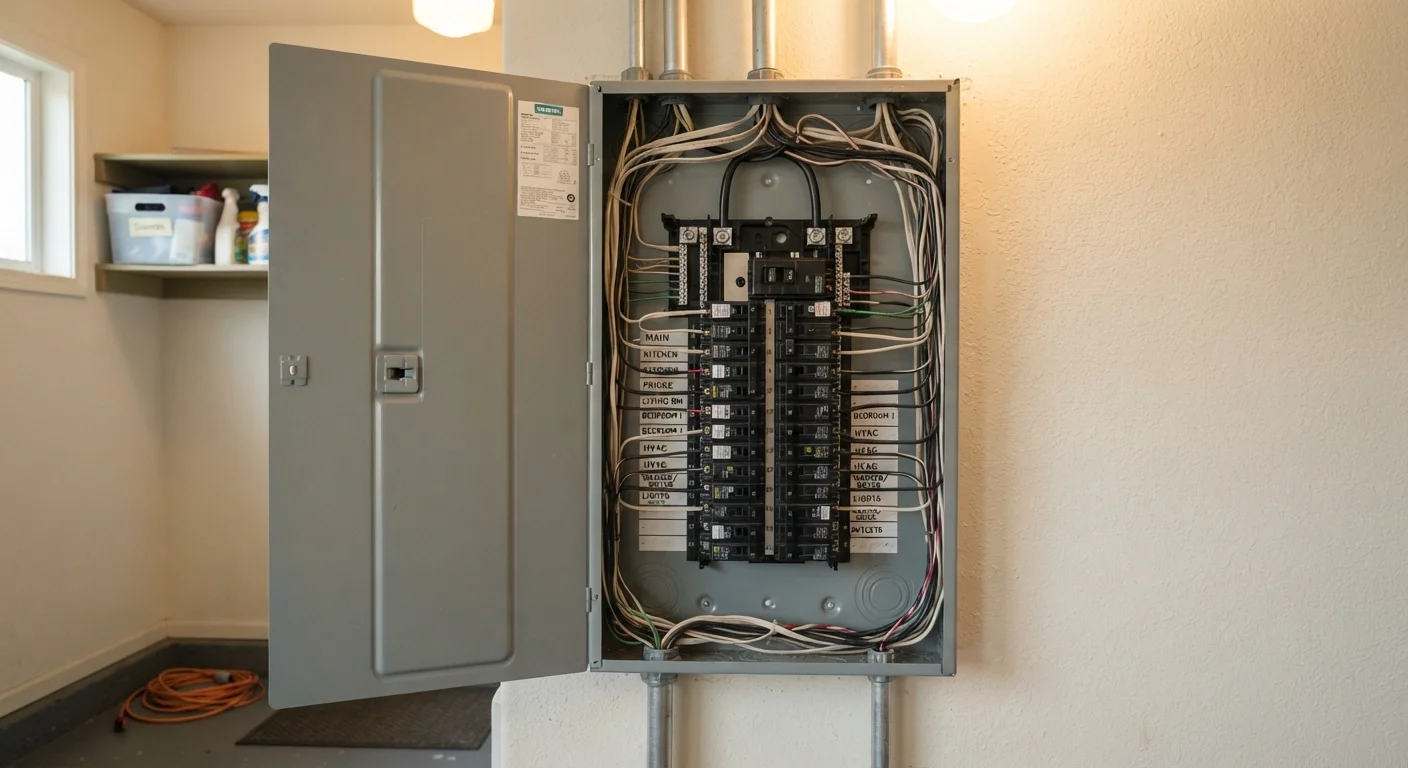
What Your Electrical Panel Actually Does
Your electrical panel - also called a breaker box or load center - is the central hub that distributes electricity from the utility company throughout your home. Utility power arrives at the panel through a pair of hot wires carrying 120 volts each (together providing 240 volts for large appliances), along with a neutral wire. The panel then splits this power into individual circuits that serve specific areas or appliances.
Each circuit is protected by a circuit breaker, which is a safety switch designed to trip - cut off power - when current exceeds a safe level. This prevents wiring from overheating and causing fires. Think of breakers as automatic guardians: they sacrifice the circuit temporarily so your wiring stays safe permanently.
For a broader foundation on tackling home systems with confidence, see our first-timer's home improvement orientation which covers essential safety basics before diving into any project.
Anatomy of a Panel: Key Parts Explained
Opening your panel's cover (the door, not the interior metal cover) reveals a structured layout worth understanding:
- Main breaker: Located at the top, this double-pole breaker controls power to the entire panel. Flipping it off cuts all power to the home - useful during emergencies or electrical work.
- Hot bus bars: Two vertical metal bars run down the center. Breakers clip onto these to draw power.
- Individual breakers: Single-pole breakers (typically 15A or 20A) handle standard 120V circuits like outlets and lighting. Double-pole breakers (30A-60A) serve 240V loads like dryers, water heaters, and HVAC units.
- Neutral and ground bars: The silver bars along the sides connect neutral and ground wires from each circuit back to the panel safely.
Use a label maker - not pencil - to mark your breaker directory, and photograph it with your phone for a permanent reference you can access remotely.
Handwritten labels fade and smear over time, and knowing your circuit layout is invaluable during an outage or when communicating with an electrician.
When resetting a tripped breaker, unplug devices on that circuit first, then firmly push the breaker fully to OFF before switching it back to ON.
Trying to reset a breaker without first reducing the load can cause it to trip again immediately, and skipping the OFF position prevents a proper reset.
Most panels also have a label directory inside the door. If yours is blank or inaccurate, circuit mapping - methodically identifying what each breaker controls - is a useful weekend project that costs nothing but time.
How to Read Your Panel's Capacity
Panel capacity is measured in amperes (amps). The main breaker's rating tells you the total amperage your panel can handle - commonly 100A, 150A, or 200A in most American homes built after the 1970s.
200A
Standard modern home panel capacity
Most homes built or rewired after the mid-1980s are equipped with 200-amp service to meet contemporary electrical demands.
80%
Safe continuous load threshold
The NEC generally requires circuits to be loaded no more than 80% of their rated capacity for continuous use to prevent overheating.
25-30 yrs
Typical panel evaluation interval
Electrical industry guidance commonly suggests having panels older than 25-30 years inspected to assess safety and adequacy for current household loads.
To assess your current load, add up the amperage of all active circuits. As a general planning guideline, electrical systems are designed to run continuously at no more than 80% of their rated capacity. A 200A panel, for example, should not sustain more than 160A of continuous draw.
If you're planning to add an electric vehicle charger, a heat pump, or a large workshop, calculating whether your existing panel has headroom - or whether you'll need a subpanel or full upgrade - is an important first step before purchasing equipment.
Warning Signs You Should Never Ignore
Many panel problems announce themselves before becoming emergencies. Knowing what to look for can help you act early:
- Breakers that trip frequently: Occasional trips are normal. Repeated tripping on the same circuit usually means the circuit is consistently overloaded - or more rarely, there's a wiring fault or a failing breaker.
- Burning smell or discoloration: Any smell of burning plastic or visible scorching around the panel or outlets is a serious warning sign requiring immediate professional inspection.
- Flickering or dimming lights: Lights that dim when appliances run may indicate an overloaded circuit or a loose connection inside the panel.
- Breakers that won't reset: If a breaker trips and won't hold in the ON position after resetting, do not force it - there may be an active fault in the circuit.
- Warm panel or buzzing sounds: A panel that feels noticeably warm or emits a persistent buzzing or crackling sound needs evaluation right away.
Do Not Open the Interior Metal Cover
The interior metal panel cover (behind the door) conceals live bus bars that remain energized even when the main breaker is off - only the utility company can de-energize these. Opening this cover without proper training and equipment poses a serious risk of electrocution. Leave all interior panel work to a licensed electrician.
When to Call a Licensed Electrician
There are a handful of tasks homeowners can handle safely around their panel: resetting a tripped breaker, reading the label directory, or mapping circuits with a non-contact voltage tester. Everything else - replacing breakers, adding circuits, running new wiring, or touching anything inside the metal interior cover - should be done by a licensed electrician.
In the US, electrical work inside panels is governed by the National Electrical Code (NEC) and local building codes. Most panel work requires a permit and inspection. Unpermitted electrical work can create safety hazards and complicate home sales or insurance claims down the line.
When evaluating contractors, ask for their state license number, proof of insurance, and whether they'll pull the required permit. This is similar advice to what you'd apply to any skilled-trade hire - the same principle of asking the right questions applies whether you're dealing with a mechanic or an electrician, as we note in our guide to getting the most from a service visit.
Panel Upgrades: What Homeowners Need to Know
Homes built before the 1980s may have 60A or 100A panels that predate modern electrical demands. Adding central air conditioning, EV charging, or electric appliances to a house wired for a simpler era can strain an undersized panel. Signs you may need an upgrade include consistently tripping breakers, no remaining circuit slots, or a licensed electrician advising that the panel is at capacity.
A full panel upgrade - replacing a 100A service with a 200A service - is a significant project involving the utility company, a permit, and an inspection. Costs and timelines vary by region and complexity; it's worth getting multiple estimates from licensed electricians to understand scope before committing.
Some older homes still contain Federal Pacific Stab-Lok or Zinsco panels, which have been associated with reliability concerns in the electrical industry. If you suspect your home has one, having it evaluated by a licensed electrician is a prudent step, not a reason to panic. Also consider including a panel check in your seasonal home preparation checklist each fall before heating systems run at full demand.
This article is for general informational purposes only and does not constitute electrical or safety advice. Always consult a licensed, qualified electrician before performing or authorizing electrical work in your home, and verify all permit requirements with your local authority having jurisdiction (AHJ).
The content provided on our blog site traverses numerous categories, offering readers valuable and practical information. Readers can use the editorial team’s research and data to gain more insights into their topics of interest. However, they are requested not to treat the articles as conclusive. The website team cannot be held responsible for differences in data or inaccuracies found across other platforms. Please also note that the site might also miss out on various schemes and offers available that the readers may find more beneficial than the ones we cover.