

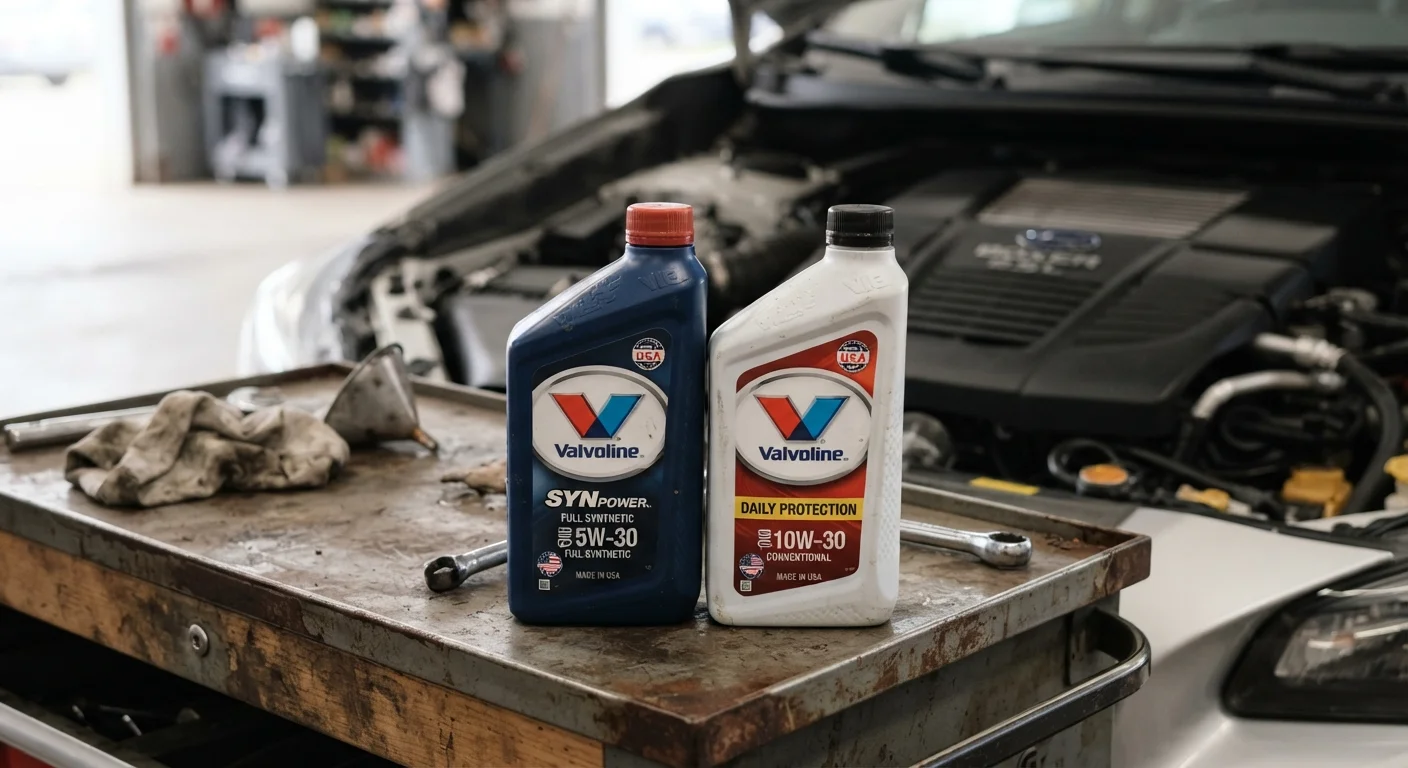
Option A
Synthetic Motor Oil
The engineered, high-performance formulation.
Best for: Drivers with newer vehicles, turbocharged engines, extreme climates, or longer service intervals.
Option B
Conventional Motor Oil
The time-tested, widely available standard.
Best for: Owners of older, lower-mileage vehicles with straightforward driving patterns and frequent change schedules.
What Actually Makes Them Different
The fundamental distinction between synthetic and conventional motor oil comes down to how each is made. Conventional oil is refined directly from crude petroleum. That refining process removes many impurities, but the resulting molecules are still irregular in size and shape, which limits how uniformly the oil performs under stress.
Synthetic oil, by contrast, is chemically engineered - either built from scratch (full synthetic) or blended with a conventional base (synthetic blend). The manufacturing process creates molecules that are more uniform in size and structure. That consistency is what gives synthetic oil its advantages in temperature extremes, high-load conditions, and extended service life.
A key property to understand is viscosity - the measure of an oil's resistance to flow. Both oil types are available across a range of viscosity grades (such as 5W-30 or 0W-20). However, synthetic oil tends to maintain its rated viscosity more reliably over time and across a wider temperature range than conventional oil does.
| Criterion | Synthetic Motor Oil | Conventional Motor Oil |
|---|---|---|
| Base composition | Chemically engineered molecules | Refined from crude petroleum |
| Typical change interval | 7,500-10,000+ miles (varies by vehicle) | 3,000-5,000 miles |
| Cold-weather flow | Excellent - flows quickly at low temps | Slower to flow during cold starts |
| High-temperature stability | High resistance to thermal breakdown | More prone to viscosity loss under heat |
| Sludge resistance | Stronger - fewer deposits over time | Higher sludge potential as oil ages |
| Cost per service | Higher upfront cost | Lower upfront cost |
| Typical use case | Modern, turbocharged, or high-performance engines | Older engines, routine driving, frequent changes |
Protection, Performance, and Longevity
During a cold start, oil must flow quickly to coat engine components before metal-on-metal wear can occur. Synthetic oil flows more readily at low temperatures, meaning critical parts receive lubrication faster. In extreme heat or under sustained high loads - think towing, mountain driving, or stop-and-go city traffic - synthetic oil also resists thermal breakdown more effectively.
Conventional oil degrades faster, both through oxidation and from the mechanical shear forces inside the engine. As it breaks down, it thickens and deposits sludge. This is why conventional oil has traditionally been paired with shorter change intervals. Synthetic oil's molecular stability means it retains its protective properties longer, which is why many manufacturers now specify extended drain intervals for vehicles using full synthetic.
That said, neither oil type makes your engine maintenance-free. All motor oil accumulates combustion byproducts, moisture, and metallic particles over time. Skipping changes - regardless of oil type - is one of the most damaging habits a driver can develop. For more on what happens when changes are delayed, see why skipping oil changes costs far more than the service itself.
5,000 mi
Typical conventional oil change interval
Many vehicle manufacturers and industry guidelines historically recommended conventional oil changes around every 3,000-5,000 miles, though this varies by engine and driving conditions.
10,000 mi
Common synthetic oil change interval
A number of modern vehicles specifying full synthetic oil carry manufacturer-recommended intervals of 7,500 to 10,000 miles or more - always verify with your owner's manual.
2x
Approximate interval difference
Synthetic oil's longer service life can roughly double the miles between changes compared to conventional oil, though actual results depend on the vehicle, oil grade, and driving conditions.
Cost, Intervals, and What Your Manual Says
Synthetic oil typically costs more per quart than conventional, and a full-service synthetic oil change at a shop will run higher than a conventional one. However, if synthetic allows your vehicle to go 10,000 miles between changes versus 5,000 miles for conventional, the number of annual services drops - and total annual cost can be comparable or even lower over time.
The most important guidance on oil type and change frequency isn't found in a TV commercial or a quick-lube shop's recommendation chart - it's in your vehicle's owner's manual. Manufacturers specify the oil type, viscosity grade, and service interval that their engineering teams validated for your specific engine. Some modern engines are designed to require full synthetic; using conventional in these vehicles can void warranty coverage or cause premature wear.
For a deeper breakdown of how to read interval recommendations, including what terms like "normal" versus "severe" driving conditions actually mean for your schedule, see our guide on oil change intervals and what your owner's manual really means.
Synthetic Blends: A Middle Ground
Synthetic blend oils mix conventional base oil with synthetic components, offering improved performance over straight conventional at a lower price than full synthetic. They can be a reasonable step up for drivers whose vehicles don't require full synthetic but who want added protection during temperature extremes or occasional heavy loads. Check your owner's manual to confirm compatibility before making any switch.
One persistent myth worth addressing: switching from conventional to synthetic in a high-mileage engine will cause leaks. This is largely unfounded. Modern synthetic oils are compatible with engine seals. However, if an older engine already has compromised seals, any fresh oil change - conventional or synthetic - may reveal pre-existing issues. When in doubt about a switch on a high-mileage vehicle, consult a qualified mechanic. You can also explore common car care myths that cost drivers money for more on this topic.
The content provided on our blog site traverses numerous categories, offering readers valuable and practical information. Readers can use the editorial team’s research and data to gain more insights into their topics of interest. However, they are requested not to treat the articles as conclusive. The website team cannot be held responsible for differences in data or inaccuracies found across other platforms. Please also note that the site might also miss out on various schemes and offers available that the readers may find more beneficial than the ones we cover.