

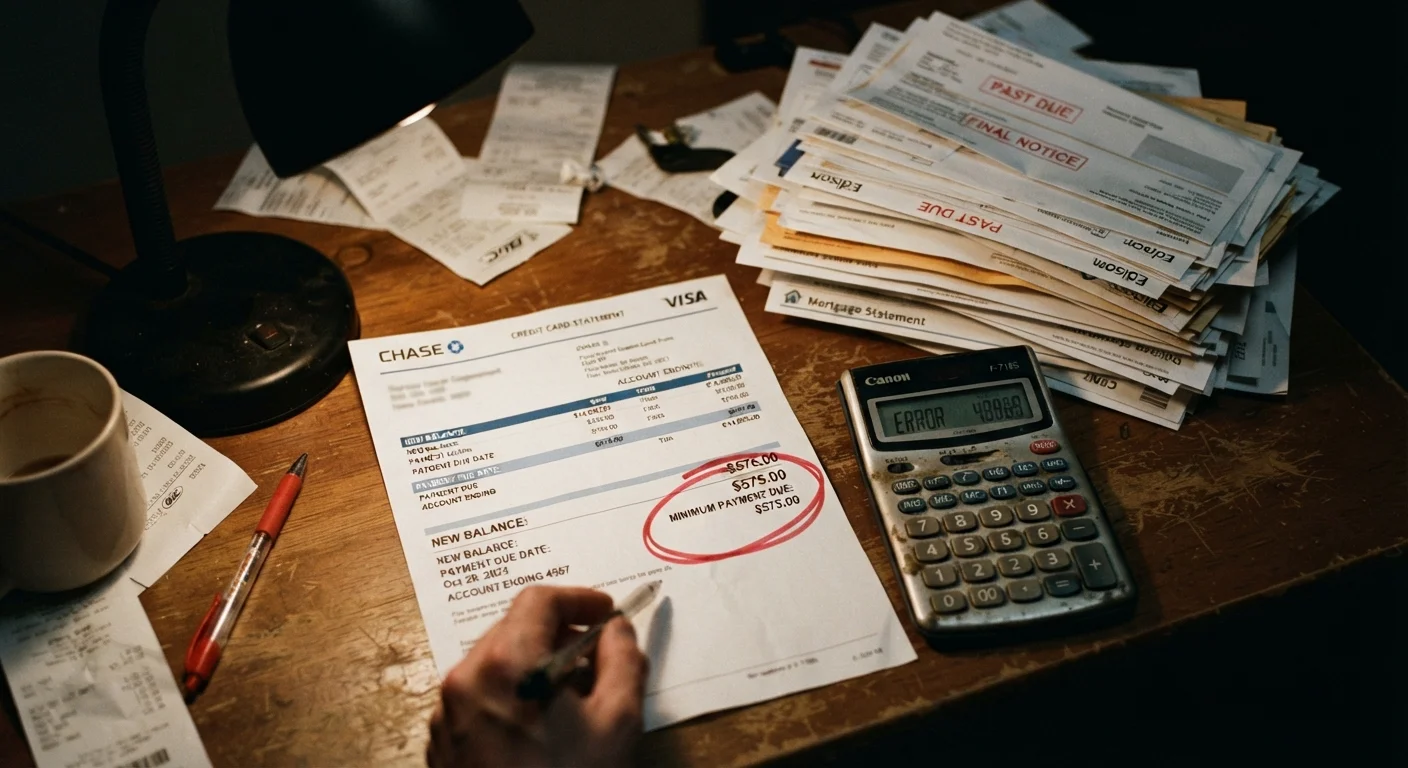
How Minimum Payments Are Actually Calculated
Most credit card issuers set the minimum payment as either a flat dollar amount (often $25-$35) or a small percentage of your outstanding balance - typically 1% to 3% - whichever is greater. Some issuers add that month's interest and fees on top of that percentage, which sounds protective but actually does very little to reduce what you owe.
Here's the problem: as your balance shrinks, so does your minimum payment. A $5,000 balance at 22% APR with a 2% minimum payment might start at $100 per month. But next month, after you've paid a little and interest has accrued, the minimum drops slightly too. This shrinking payment is called a negatively amortizing structure - you're barely outrunning the interest charge each cycle. The card issuer isn't doing anything illegal; minimum payments meet the regulatory floor. But meeting the floor keeps you on the treadmill.
Treating the minimum payment as the 'right' payment amount.
Why it happens: The minimum appears on every statement as the only figure requiring action, so many people assume it's the intended monthly cost of carrying the card.
Ignoring how daily compounding amplifies the balance.
Why it happens: Most people think of interest as a monthly charge, so the true cost of carrying a balance day-to-day stays invisible until the statement arrives.
Continuing to spend on a card while only paying the minimum.
Why it happens: New purchases feel separate from the existing balance, but they share the same interest rate and compound together, accelerating the debt.
Assuming a good payment history means the debt strategy is fine.
Why it happens: Paying on time - even the minimum - avoids late fees and keeps your account in good standing, which can feel like financial success.
Not having a payoff target date or end-goal in mind.
Why it happens: Without a specific goal, the debt feels like a permanent fixture - something to manage rather than eliminate - which removes urgency from the payment decision.
The Mistakes That Keep People Stuck
Understanding the mechanics is one thing. Recognizing the specific habits and assumptions that lock people into minimum-only payments is where the real insight lives. Each of the errors below is common, understandable - and fixable.
20+ years
Estimated repayment time on minimum-only payments
Consumer Financial Protection Bureau analyses have shown that minimum-only repayment on a mid-size credit card balance at typical interest rates can extend the payoff period by two decades or more.
~22%
Average credit card interest rate in recent years
Federal Reserve data has tracked average credit card rates trending upward, making the compounding effect of minimum payments more costly than in prior low-rate environments.
If you're also sorting out which debts to prioritize once you start paying more, it's worth reading about the debt avalanche vs. the debt snowball - a practical look at how different approaches compare on total interest cost and motivation.
What Paying More Actually Does to Your Timeline
The math here is striking. Consider a $3,000 credit card balance at 20% APR. Paying only the minimum (estimated at 2% of the balance) could take over 20 years to fully repay and cost more than $3,000 in interest alone - meaning you'd pay more in interest than the original debt. By contrast, paying a fixed $150 per month cuts that timeline to roughly two years and reduces total interest to around $650. That's a difference of thousands of dollars for a relatively modest payment increase.
The Interest You Don't See Coming
On a $3,000 balance at 20% APR, paying only the minimum could result in total interest charges that exceed the original debt - meaning you pay for the same purchase more than twice. This isn't a worst-case scenario; it's a predictable outcome of how compound interest works over time. Running the numbers on your own balance using a free payoff calculator takes under five minutes and often changes how urgently people treat their payment strategy.
This is why budgeting habits matter as much as debt strategy. If your budget doesn't carve out space for above-minimum payments, the math works against you by default. The budgeting basics hub offers practical frameworks for finding that extra room without overhauling your life.
It's also worth knowing that carrying a high balance relative to your credit limit - your credit utilization ratio - can drag down your credit score even if you're paying on time. Faster payoff improves both your financial position and your credit profile. See habits that support a healthier credit profile for more on that connection.
This article is for general informational and educational purposes only and does not constitute personalized financial or legal advice. Consult a qualified financial professional for guidance specific to your situation.
The content provided on our blog site traverses numerous categories, offering readers valuable and practical information. Readers can use the editorial team’s research and data to gain more insights into their topics of interest. However, they are requested not to treat the articles as conclusive. The website team cannot be held responsible for differences in data or inaccuracies found across other platforms. Please also note that the site might also miss out on various schemes and offers available that the readers may find more beneficial than the ones we cover.