

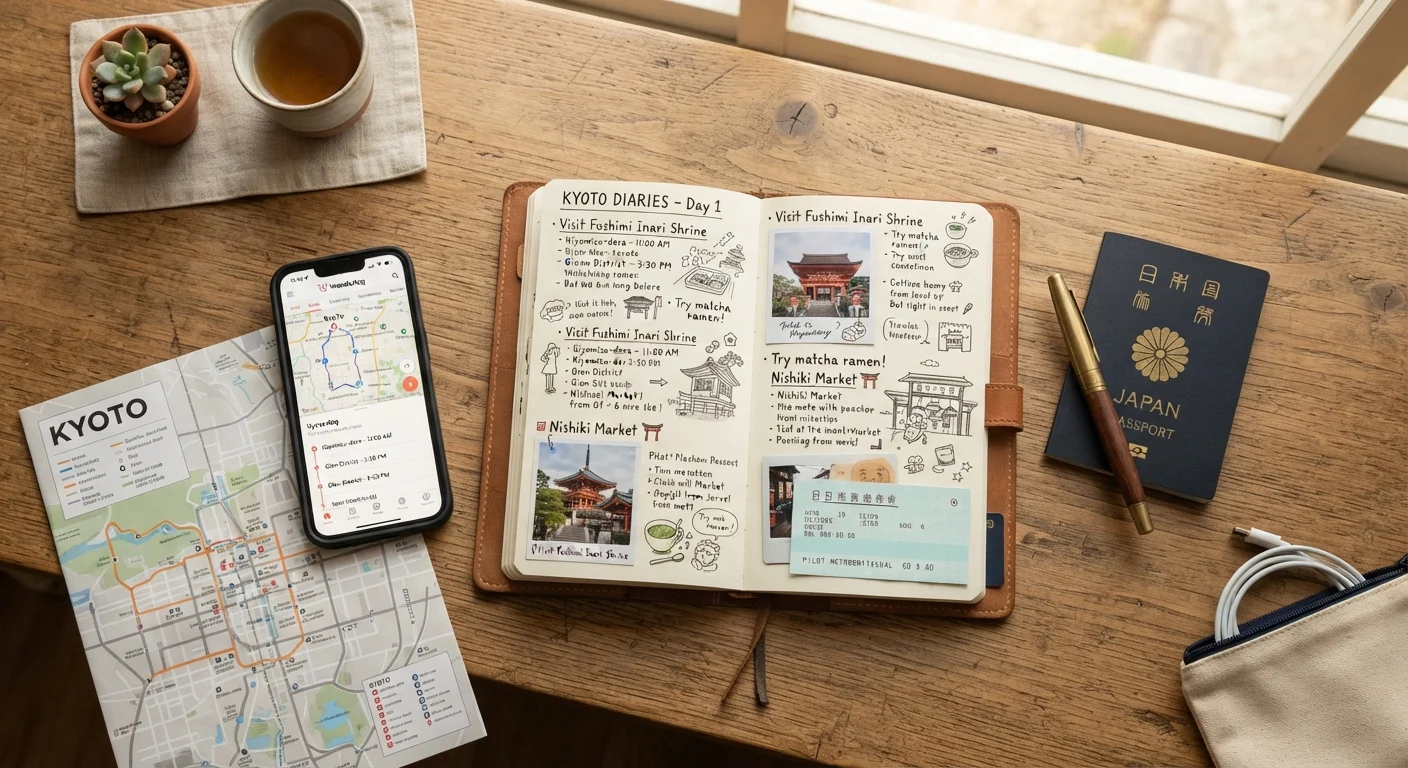
Option A
Digital Trip Planning
The connected, real-time approach to organizing travel.
Best for: Travelers who want live updates, shared access, and centralized booking records across devices.
Option B
Paper Trip Planning
The tactile, offline method that never runs out of battery.
Best for: Travelers who think better on paper, prefer fewer screens, or plan to visit areas with unreliable connectivity.
What Each Approach Actually Offers
The debate between digital and paper planning often gets framed as a generational preference, but the real distinction is functional. Each method has concrete strengths - and understanding them helps you make a deliberate choice rather than defaulting out of habit.
Digital tools - whether dedicated travel apps, shared documents, or calendar integrations - excel at aggregation. They pull confirmations, maps, and schedules into one place, sync across devices, and can be shared instantly with anyone on your trip. When a flight changes, a well-organized digital system surfaces that information faster than any paper file.
Paper planning works differently: it's unconditional. A handwritten itinerary doesn't need Wi-Fi, doesn't push notifications mid-dinner, and doesn't require you to remember a password at a foreign border. For many travelers, the act of writing details by hand also improves retention - you're more likely to remember a museum's closing day if you wrote it down yourself. See our breakdown of the key trip planning phases for context on where each tool fits best.
| Criterion | Digital Planning | Paper Planning |
|---|---|---|
| Offline reliability | Requires signal or pre-downloaded content | Works anywhere, no connectivity needed |
| Real-time updates | Automatic sync when connected | Manual updates only |
| Sharing with co-travelers | Instant via shared link or app | Requires copying or printing |
| Risk of data loss | Device loss or app failure | Physical loss or damage |
| Ease of editing | Quick and frictionless | Deliberate; requires rewriting |
| Battery dependence | High - needs charged device | None |
| Best for complex bookings | Strong - centralizes confirmations | Manageable for simple trips |
Where Each Method Shows Its Weaknesses
Digital planning's core vulnerability is dependency. Apps go offline, phones get lost, and battery life runs out at inconvenient moments. Over-reliance on a single app - without printed backups - can leave you scrambling if that app crashes or requires connectivity you don't have. There's also a subtler problem: the ease of adding items digitally can lead to over-scheduling. When editing is frictionless, itineraries expand to fill every gap. For a clearer look at how overloaded plans unravel, explore common trip-planning missteps.
Paper planning, meanwhile, doesn't update itself. If your train time changes after you've printed your schedule, you need to catch that manually. It also doesn't scale gracefully for complex, multi-destination trips where dozens of confirmation numbers need to be tracked. Sharing a paper itinerary with co-travelers requires photocopying or rewriting - a meaningful friction point when plans evolve frequently.
A Note on Digital Backups
Regardless of which planning method you prefer, it's worth emailing yourself key confirmation numbers, accommodation addresses, and emergency contacts before you leave. A simple email thread requires no special app and can be accessed from any internet-connected device worldwide - including a hotel lobby computer if your phone is lost or stolen. Think of it as a low-tech safety net that complements whichever primary system you use.
Building a Hybrid System That Holds Up
For most travelers, the smartest approach isn't choosing one method exclusively - it's assigning each method to what it does best. Use digital tools to store and organize bookings, confirmation numbers, and real-time documents. Use paper for your day-level itinerary: the sequence of neighborhoods, the approximate timing, the addresses you'll actually need on the street.
A practical starting point: draft your day-by-day plan digitally using a structured format - learn how to structure a workable itinerary - then print a condensed version to carry. Keep one printed sheet per day with key addresses, confirmation numbers, and a rough timeline. That paper page works anywhere, and your digital version remains the living document you update as plans shift.
Before you finalize your system, also consider your destination. A city trip with strong mobile coverage favors digital-heavy planning. A rural hiking route or an international destination with expensive data plans tips the balance toward paper. The complete trip-planning reference can help you map those decisions to a realistic timeline.
This article provides general travel planning guidance for informational purposes only. Always verify booking details, local conditions, and connectivity directly with relevant providers before you travel.
The content provided on our blog site traverses numerous categories, offering readers valuable and practical information. Readers can use the editorial team’s research and data to gain more insights into their topics of interest. However, they are requested not to treat the articles as conclusive. The website team cannot be held responsible for differences in data or inaccuracies found across other platforms. Please also note that the site might also miss out on various schemes and offers available that the readers may find more beneficial than the ones we cover.