

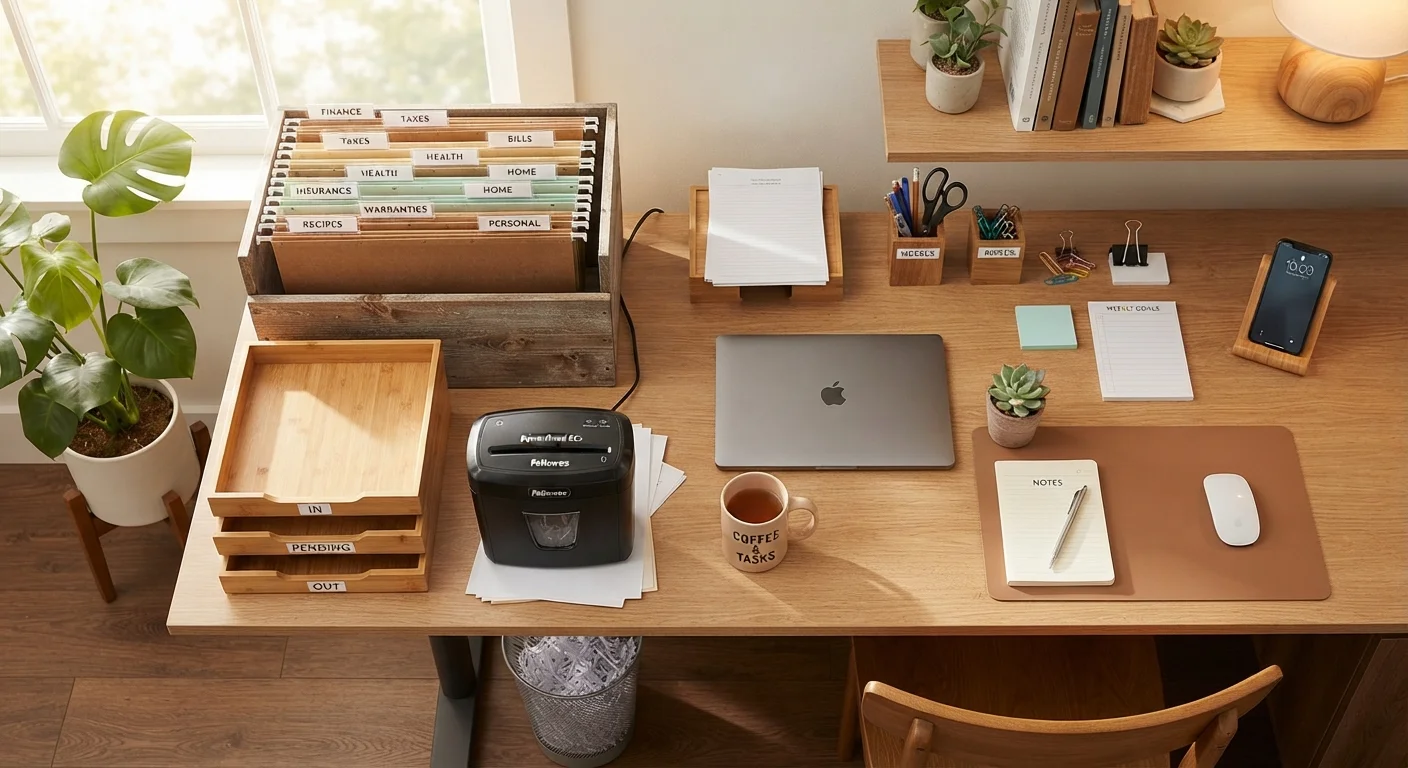
Why Paper Piles Keep Coming Back
Paper clutter is uniquely persistent because it arrives constantly - mail every day, receipts from every purchase, school forms, medical paperwork, and insurance documents. Most households don't have a system for incoming paper, so it lands wherever there's space: the kitchen counter, the dining table, a catch-all drawer. Over weeks, manageable stacks become overwhelming piles.
The root cause is rarely laziness. It's the absence of a clear, low-friction decision-making process for each piece of paper that enters the home. Without defined categories and a designated home for each type of document, every item becomes a small decision deferred - and deferred decisions pile up fast.
If your home also has shared-space dynamics where household members handle paper differently, organizing with multiple people in mind adds a useful layer to this process. And if paper is just one part of a broader clutter challenge, getting started with home organization provides the wider context.
Go Paperless Where It Makes Sense
Most banks, insurers, and utilities offer electronic statements and billing. Switching to digital delivery for routine statements dramatically reduces incoming paper without sacrificing access to records. You can typically download PDFs of statements whenever needed, and many institutions store several years of history online.
What You'll Need Before Starting
Setting up a functional paper system requires only a handful of basic supplies. Having these ready before you begin the sorting process makes the work faster and more satisfying.
Desktop mail sorter or inbox tray
Holds incoming mail at a single landing spot so paper never piles up across the counter.
Accordion folder or hanging file system
Provides labeled, categorized storage for documents you need to retain long-term.
Cross-cut shredder
Safely destroys documents containing sensitive personal or financial information.
Fireproof document box or safe
Protects permanently important records such as passports, deeds, and birth certificates.
Label maker or adhesive labels
Clearly marks file folders and bins so the system is easy to maintain over time.
What you will need
Once you have your supplies in place, the step-by-step process below walks you through clearing the backlog and setting up a system that's easy to maintain. For a broader framework on tackling any cluttered space before you dive in, start with this foundational approach.
How to Build and Maintain Your Paper System
Follow these steps in order to clear your existing backlog and put a durable daily system in place. The first session takes the most time; maintaining it afterward is a matter of minutes each day.
Gather every piece of paper in the house
Before building any system, you need a complete picture of what you're dealing with. Walk through every room and collect all paper: mail, receipts, statements, manuals, school papers, and anything else that has accumulated. Bring it all to one table or workspace.
This initial gather is the foundation step covered in the right order of operations for organizing - sorting before you have everything visible almost always leads to redoing the work.
Sort everything into three primary piles
Divide your paper collection into three distinct categories:
- Action-needed: Bills to pay, forms to complete, appointments to schedule, items requiring a response.
- File-to-keep: Documents you need to retain but require no immediate action - statements, warranties, tax records, insurance policies.
- Shred or recycle: Junk mail, expired coupons, old receipts you no longer need, outdated instruction manuals for items you no longer own.
Don't overthink individual items at this stage. The goal is a fast, broad sort - refinement comes in the next steps.
Process your action-needed pile immediately
Once sorted, address the action-needed pile right away. Pay overdue bills, respond to time-sensitive correspondence, and schedule any appointments. For items that can't be completed immediately, note them in a to-do list or calendar and place them in a dedicated action inbox tray - a single visible spot where pending tasks live until resolved.
This tray should be checked and cleared at least once a week to prevent it from becoming another pile.
Set up a simple filing system for documents to keep
You don't need an elaborate system. An accordion folder with labeled sections or a small set of hanging files covers most households. Useful core categories include:
- Taxes & Financial Records
- Insurance Policies
- Medical Records
- Home (mortgage, deed, repairs)
- Vehicle (title, registration, service records)
- Warranties & Manuals
- Legal & Identity Documents
Label clearly and file documents into their matching section. Vital records - passports, birth certificates, Social Security cards, property deeds - deserve a fireproof box or safe rather than a standard folder.
Shred and recycle the discard pile
Work through your shred-or-recycle pile systematically. Anything with personal identifying information - full name paired with account numbers, medical details, Social Security numbers, or financial data - goes through the shredder. Plain marketing mail, catalogs, and general junk can go directly into the recycling bin.
[important_callout]Create a daily mail habit going forward
The system only works if paper doesn't accumulate again. Designate one spot - a counter, shelf, or tray near the front door - as the mail landing zone. Each day when mail arrives, immediately sort it into action-needed, file-to-keep, or shred-or-recycle. This takes under two minutes when done daily and prevents the backlog from returning.
Opting into paperless billing and statements where possible is one of the most effective ways to reduce incoming paper volume at the source.
Don't Discard Vital Records Prematurely
Some documents - such as tax returns, property deeds, insurance policies, and medical records - should be retained for years or permanently. When in doubt about how long to keep a specific document, consult IRS guidance or a qualified financial or legal professional before discarding it.
Once your system is established, the habits that keep it running are the same ones that keep any organized space functional over time. Simple daily habits make the difference between a system that lasts and one that collapses after a few weeks.
The content provided on our blog site traverses numerous categories, offering readers valuable and practical information. Readers can use the editorial team’s research and data to gain more insights into their topics of interest. However, they are requested not to treat the articles as conclusive. The website team cannot be held responsible for differences in data or inaccuracies found across other platforms. Please also note that the site might also miss out on various schemes and offers available that the readers may find more beneficial than the ones we cover.