

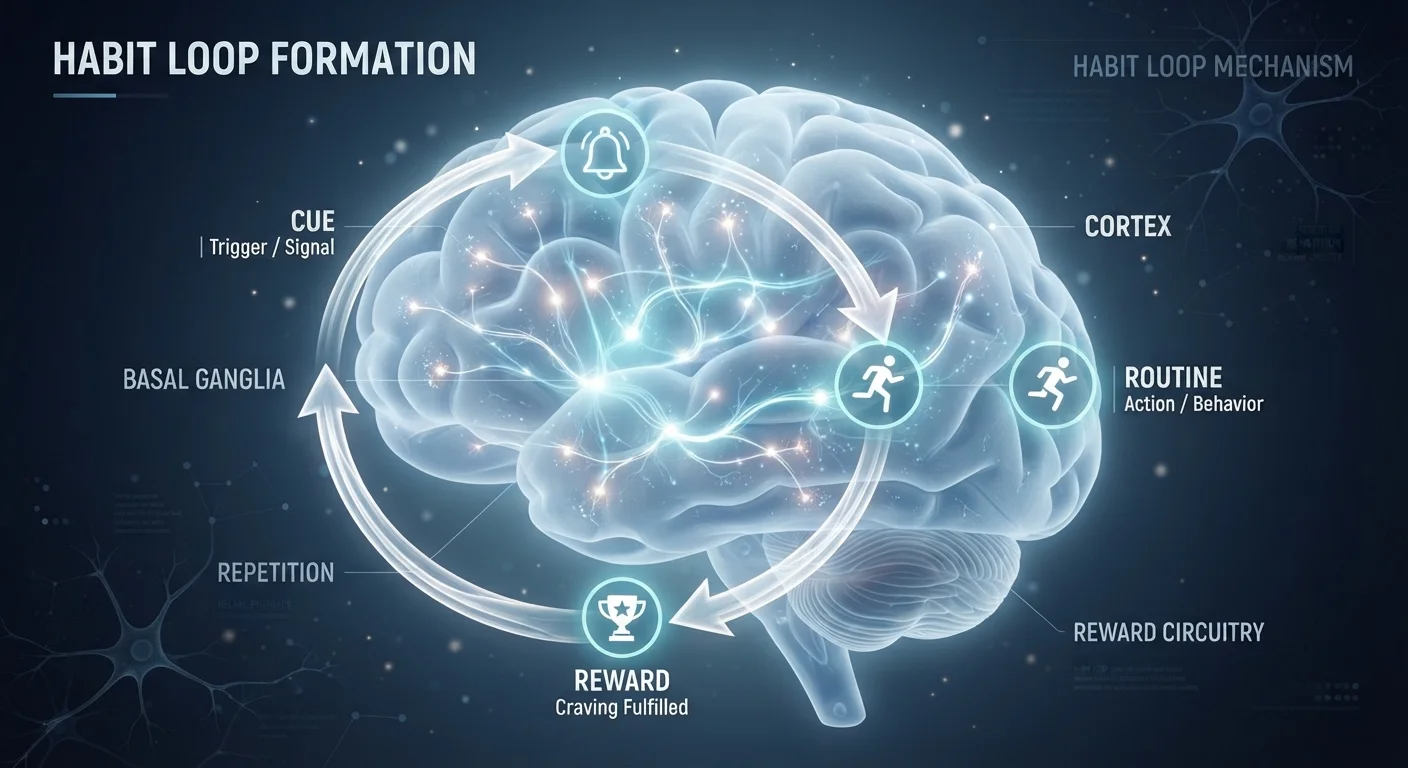
The Neurological Engine Behind Automatic Behavior
Every habit you have - whether checking your phone first thing in the morning or lacing up sneakers before a walk - was once a deliberate choice. What changed is neurological. Through repetition, the brain shifts control of routine actions from the prefrontal cortex, which manages conscious decision-making, to the basal ganglia, a deeper structure specialized in procedural memory.
This transfer is efficient by design. Automating familiar behaviors frees cognitive resources for novel problems. The trade-off is that once a behavior is encoded as a habit, it runs largely outside awareness - which is why unwanted habits can feel so difficult to override.
The foundational framework for understanding this process is the habit loop, consisting of three elements: a cue (a trigger in the environment or internal state), a routine (the behavior itself), and a reward (a positive outcome that reinforces repetition). Each time the loop completes, the neural connection strengthens. Over enough repetitions, the cue alone begins to activate the behavior automatically.
Missing a Day Doesn't Break the Chain
Research on habit formation shows that occasional lapses do not erase the progress already encoded. What matters most is returning to the behavior promptly after a disruption rather than maintaining a perfect streak. Consistency over time, not perfection day to day, is what builds automaticity.
Why the '21 Days' Myth Persists - and What Research Actually Shows
The idea that any habit can be locked in within 21 days has circulated in popular culture for decades, originating from observations by a plastic surgeon about patient adjustment times - not a controlled behavioral study. Research published in the European Journal of Social Psychology by Phillippa Lally and colleagues at University College London found that the actual range spans roughly 18 to 254 days, with a median closer to 66 days.
What drives the variation? Complexity matters significantly. Drinking a glass of water with breakfast automates faster than a 30-minute workout. Consistency of context matters too - performing a behavior in the same setting, at the same time, accelerates encoding. Importantly, occasional missed days did not eliminate progress in the UCL study, which is reassuring for anyone navigating a realistic schedule.
66 days
Average time for a habit to become automatic
According to a study by Lally et al. published in the European Journal of Social Psychology, the median habit formation time across participants was approximately 66 days, with wide individual variation.
40-45%
Daily behaviors that are habitual, not deliberate
Research by Wendy Wood and colleagues at Duke University estimated that roughly 40-45% of everyday actions are performed habitually rather than through active decision-making.
18-254 days
Full range of habit formation timelines observed
The same UCL study found the range of days to automaticity varied enormously depending on behavior complexity and individual consistency, challenging any fixed-day rule.
Environment Design: The Underrated Driver of Lasting Change
Motivation is a useful spark but a poor engine. Behavioral science repeatedly demonstrates that environmental cues - what you see, what is within reach, what your surroundings prompt - are more powerful predictors of behavior than intention alone.
This is why habit formation experts often prioritize environment design over willpower-based strategies. Placing running shoes by the door, preparing tomorrow's lunch the night before, or leaving a book on your pillow are all examples of reshaping the cue landscape to make desired behaviors more likely and competing behaviors less convenient.
This principle applies broadly. The behavioral strategies behind sustainable exercise - including cue design and identity-based framing - draw directly from the same science. Similarly, organization habits that last work because they restructure the environment rather than demand ongoing discipline.
Design Your Environment Before Testing Willpower
Before relying on motivation to start a new habit, spend five minutes rearranging your physical environment to make the desired behavior the easiest available option. Remove friction from good behaviors and add friction to competing ones. This single shift can matter more than commitment alone.
Habit Stacking and the Role of Existing Routines
One of the most evidence-informed strategies for building new habits is habit stacking - attaching a new behavior to an already-established one. The existing habit serves as a reliable cue, reducing the need to create a new trigger from scratch. For example: After I pour my morning coffee, I will write three things I'm grateful for.
This approach works because it leverages an already-encoded neural pathway to introduce a new behavior. Over time, the new action inherits some of the automaticity of its anchor habit.
The same principle appears in learning research. Spaced repetition succeeds partly because it builds a consistent retrieval routine - a form of habit stacking applied to learning. For a broader framework on building habits across multiple life domains, see this whole-person approach to daily habits.
This article is for informational purposes only and does not constitute medical or psychological advice. Consult a qualified healthcare professional for guidance specific to your circumstances.
Frequently Asked Questions
Research published in the European Journal of Social Psychology found that habit formation ranged from 18 to 254 days, with an average of around 66 days - far longer than the popular '21-day' claim. The timeline depends on the complexity of the behavior and how consistently it is practiced.
The habit loop is a three-part neurological cycle: a cue triggers a routine, which produces a reward. Understanding this loop matters because changing a habit is most effective when you identify and modify the cue or reward rather than relying solely on self-discipline.
Habits are context-dependent - disruptions like travel, illness, or stress can interrupt the cue-routine chain before full automaticity is reached. Missing occasional days does not erase progress, but rebuilding the cue environment quickly after a disruption helps restore the pattern.
Motivation can initiate a new behavior but is not reliable for maintaining it. Research consistently shows that environmental cues and established routines are stronger predictors of long-term habit maintenance than sustained motivation or willpower.
Working on several habits simultaneously can strain the cognitive resources needed to encode each one. Many behavioral researchers suggest focusing on one to two habits at a time and using habit stacking - linking new behaviors to existing ones - to build gradually.
A routine is a deliberate sequence of actions that still requires conscious intention. A habit is a behavior that has become sufficiently automatic that it is triggered by contextual cues with minimal conscious decision-making. All habits begin as routines.
The content provided on our blog site traverses numerous categories, offering readers valuable and practical information. Readers can use the editorial team’s research and data to gain more insights into their topics of interest. However, they are requested not to treat the articles as conclusive. The website team cannot be held responsible for differences in data or inaccuracies found across other platforms. Please also note that the site might also miss out on various schemes and offers available that the readers may find more beneficial than the ones we cover.